
Object Record
Images
Metadata
Accession number |
1994.203 |
Object Identification Number |
1994.203.445g |
Object Name |
Pin, Fraternal |
Donor |
Danish Brotherhood in America |
Description |
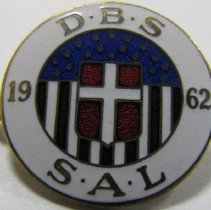
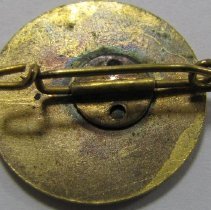
A pin, Danish Brotherhood. The circular pin is made from metal. The edge is white with gold lettering that reads "DBS / 1962 / SAL." At center, there is a circular design featuring a version of the American flag with a small Danish flag design at center. The back is gold and has a horizontal pin post that hooks under a loop, allowing the pin to be secured to clothing. |
Dimensions |
Dia-0.875 inches |
Creation Date |
ca. 1962 |
Owned By |
Skelbeck, Axel |
Used By |
Skelbeck, Axel |
Material |
metal |
Associated People |
Danish Brotherhood in America |
Search Terms |
Danish Brotherhood in America Danish Brotherhood Society DBIA DBS DB pin 1962 faternal pin SAL |
Provenance |
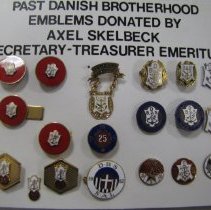
This pin was owned by Axel Skelbeck, secretary and treasurer emeritus of the Danish Brotherhood in America. Part of a 19 piece collection originally on a piece of matte board. ----------------------------------------------------- The Danish Brotherhood in America (DBIA), originally Det Danske Brodersamfund, was a national fraternal insurance association for Danish immigrant males. Formed in Omaha, Nebraska in 1881 as an outgrowth of several Danish immigrant veterans organizations, the organization was initially open to "honorable men, born of Danish parents or who were of Danish extraction." The first six lodges were chartered in July of 1882, and other lodges soon arose in many communities where significant numbers of Danes had settled. The organization provided a forum for nurturing Danish culture and language as well as providing financial assistance to members in case of death or illness. Some 350 lodges were in the United States along with three in British Columbia and one in Copenhagen, Denmark. In 1916, a monthly publication titled "Det danske Brodersamfunds Blad" ("The Danish Brotherhood Magazine"), later renamed The American Dane, began to further communication among members and lodges. After 1920, as Danish immigration lessened and the number of eligible males dwindled, lodges opened their membership to include American-born daughters and later spouses and children of lodge members. The DBIA gradually evolved into a social organization for the entire family. Some lodges were disbanded after a few decades due to economic conditions or changes in the ethnic base of their communities. Remaining members were then transferred to nearby lodges or paid their insurance premiums directly to organization headquarters in Omaha (Lodge #600). In August 1995, the insurance function of the DBIA was merged into Woodmen of the World and/or Assured Life Association. A number of DBIA lodges remain active today as organizations that promote the pride of Danish culture and origin. |
Images |
216\1994203445g.JPG |
Date Received by Museum |
08/22/1994 |