
Object Record
Images
Additional Images [6]
Metadata
Accession number |
1995.180 |
Object Identification Number |
1995.180.001 |
Object Name |
Sampler |
Donor |
Ivory, Grethe Lindholm |
Description |
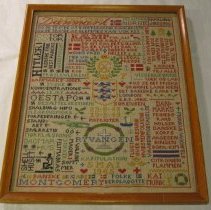
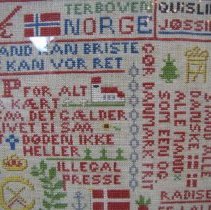
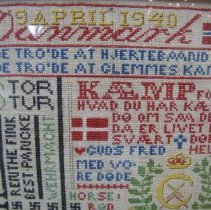
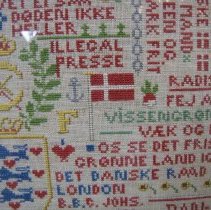
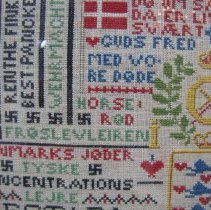
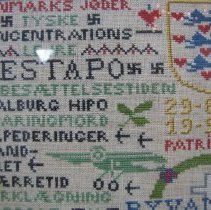
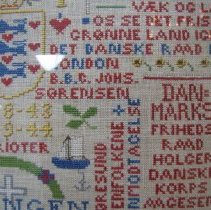
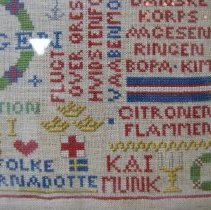
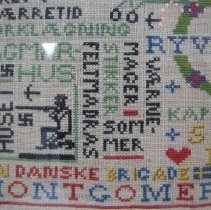
Multicolored sampler, embroidered on linen, regarding World War II. The entire surface is packed with numerous phrases, names, and dates. There are a few images stitched in with the words, such as three lions representing the royal family, an airplane, swastikas, a cross, and a "C" with an "X" inside representing Christian the 10th. Several countries are represented by stitched flags including Denmark, Sweden, and Norway. The text is primarily in Danish. The sampler is housed under glass in a wood frame. The frame is stained a blonde color with a semi-gloss finish. |
Dimensions |
W-15.5 L-19 D-0.75 inches |
Creation Date |
ca. 1945 |
Place Of Origin |
Denmark/Copenhagen |
Owned By |
Ivory, Grethe Lindholm |
Material |
Cloth/Glass/Linen/Thread/Wood |
Associated People |
Ivory, Grethe Lindholm Puck, Louise |
Search Terms |
Ivory, Grethe Lindholm WWII resistance Copenhagen liberation Norway Denmark Sweden flags airplanes swastikas linos crown hearts Germany natzis Puck, Louise Clara Wæver embroidery |
Provenance |
Multicolored sampler, embroidered on linen, regarding World War II. The pattern was made by Louise Puck and sold by Clara Wæver, an embroidery shop, and was sold until 1970. The sampler was featured in The Danish Immigrant Museum's newsletter the "America Letter" in the spring of 2009 and in an article in Den Danske Pioneer and in Bien in March of 2009. Information sent by a reader of that America Letter: We have here in Copenhagen a "Museum of Danish Resistance 1940-1945". I went there today, and they exhibit four of these samplers, a little varying in size, but all of them exactly the same as yours. The accompanying text says: "The design was sold by the thousands until 1970. On the left side the "evils of the occupation" are represented in black and green colors (the Germans). On the right the Resistance is represented in the Allied colors. In the middle are yellow symbols of the Danish Royal House. The design is akin to that of embroideries of "family trees" which were common in the 18th and 19th centuries." As to the contents: The top line goes "9th April 1940", that was the day the Germans occupied Denmark and Norway. Terboven, Quisling and Jøssing are the three most famous Norwegian Nazis who on behalf of the Germans governed Norway during the five years as the Norwegian royal family and government fled to England. It is also a Norwegian flag. The two blue lines are lines from a national anthem written after the Prussian/Danish war 1864, when the Prussians took one third of the Danish Kingdom, the whole south of Jutland. It goes more or less "and they thought they can change our hearts, and they thought they can make us forget our rights". It was much sung when I was a child during and after the war. The box of black and green letters under that names SS, Hitler, Renthe Fick, Best and Pancke, some of the German administrators in Denmark during the occupation. And as you can probably guess mentions torture and Wehrmacht = the German army. And four swastikas. The red letters in the top centre "Kæmp for …." The first verse of a well known Danish hymn which again was extremely popular during the war. "Fight for all the things you love, even die for them if necessary, then life will not be too difficult, neither will death". Blue letters to the left of the wreath "Guds fred med vore døde", a line from another national anthem from 1864, the Danish king Christian X used to end all his speeches during the war citing this verse. This line goes "God's peace be with our dead". Green/red letters - Horserød is the name of a prison used for interring communists, later Jews, and all other civilians waiting to be sent off to German concentration camps. It is in North Sealand, and it is still a prison. The wreath with green oak leaves (national symbol) and yellow crowns is in honor of the royal family, CX was the king, I and F are the Crown Princess Ingrid and the Crown Prince Frederik, later king and queen themselves and parents of our present Queen Margrethe. To the right of that it says "underground press", the Danish flag and a picture of a radish and in red letters underlined "radishes". I cannot find an explanation for that, I do not remember anything with or about radishes. The red "box" on the right on top two Christmas trees and a yellow F7 under a crown = Frederik VII, who in 1848 gave us the first free constitution. The text "Gå til mod-…." is the first verse from the very popular song from the days just after the liberation "Join the resistance everybody as one man and make Denmark a free country again". Something like that. Under that and the radishes red and green letters "Fej alle vissengrønne….." "Sweep away alle the moss green (in green letters = the German soldiers) and let us see the bright green land again", from another part of the above song. Two lines in red and blue letters "Det danske råd I London…. BBC Johs Sørensen". A Danish council in London which had a voice through BBC, i.e. a Dane called Johannes Sørensen. Centre the coat of arms of the Danish kings, three blue lions and nine red hearts. Goes back to the Middle Ages. To the left of that - red line Danske jøder = Danish Jews Green and black lines "Tyske …." = German/concentration/camps/GESTAPO/The Occupation/ Schalburg Hipo = Danish Nazi paramilitary organizations/Clearing murders/ Torpedoings/Military courts/Curfew/Blackout Centre dates 29.8.43 = the day they went after the Jews / 19.9.44 = the day they arrested most of our policemen and sent them to Neuengamme and other concentration camps. Under that in red letters - "Patriots" and a fishing boat (they sailed the Jews and resistance members across the sound to Sweden. Wreath with cross and Ryvangen = a place on the outskirts of Copenhagen where particularly during the last months of the occupation lots of resistance members were shot. After the war the place was turned into a memorial park. Red letters and blue to the right of the wreath vertically "Flugt over Øresund" (see above; flugt = flight). Hvidstenfolkene was a resistance group in Hvidsten in Jutland. They were all except one caught and shot shortly before the end of the war. "Våbenmodtagelse" = dropping operations of arms. Horizontally: "Danmarks frihedsråd etc" = various resistance groups. Monica Emily (Beresford) Wichfeld (nee Massy Beresford) was born July 12, 1894 in London, married a Danish aristocrat and diplomat (Jorgen Adalbert Wichfeld) and died February 27, 1945. She was a leading member of the Danish Resistance during the German occupation of Denmark. She was arrested in 1944, interrogated daily for four months, and sentenced to death but was later given life imprisonment. She died of tuberculosis one month before the end of WWII. "Flammen/Citronen" - two young men who specialized in liquidating informers. They were both killed or executed shortly before the end of the occupation. Last year there was a film about them, a great success, but both my husband and I found it utterly boring. Their cover names were Flammen = the flame, he was a redhead, Citronen = the lemon, but I do not know why he was called that. The green/black "box" on the left Dagmarhus = the building where the German civil administration had their offices. Shell-huset = the building Gestapo used for their headquarters in Copenhagen. Bombed by the British at the end of March, 1945. Unfortunately they also hit a school. Vertically: Collaborator/Informer/tart Sommer = a well known Danish Nazi. Under the wreath - Capitulation 5th May 1945 in yellow, The Red Cross symbol with three small yellow crowns on top. The bottom two lines red, blue and yellow. From the left: Den danske brigade = an army raised in Sweden by Danish refugees. Swedish and Danish flags. Montgomery, the liberator of Denmark. Folke Bernadotte, the Swede who arranged transport of Danes from concentration camps back to Denmark. Another Swedish flag. Kaj Munk = a Danish poet and dramatist and vicar who spoke freely against the Germans and was abducted and shot in 1944. ---------------------------- Information from Lis Jorgensen, museum member, 4/29/2009-- *"Citr Onen" and Flammen"--underground fighters, movie made of them *"Kim Malthe Brun"--in Number the Stars book *"Ryvangen"--in suburb of Copenhagen. The Nazis had posts there, shot Danish fighters. There is a memorial park there now. *"Quisling" at the top--referred to any Norwegian traitor *"KAEMP"--song used a lot *Lower left--list of resistance groups, starts with "DAPG" *"Shalburg"--Danes that went into the German army--used for cannon fodder. Considered traitors by the Danes (see below "GESTAPO") *"Frøslev"--was a concentration camp on the border between Denmark and German *"Dagmar Hus"--("Shell Huset" same thing)--well built building. Shell Oil Company's building. The Nazis took it over because it was so well built. Kept well known prisoners there, on the top floor so the British wouldn't bomb the building. Torture took place in the basement. The British came in and "skip bombed" the building--went in at other levels, instead of dropping bombs on the top of the building. Prisoners escaped during that bombing--they had been told to walk calmly if they ever got out so many of those that followed that direction were able to escape. *"Kai Munk"--minister that was murdered, dumped in a ditch *"Montgomery"--British man, first one to come with his troops at the end and was greeted royally when Denmark was liberated. *"Horserød"--on Sjelland, concentration camp *"Gaa til mod...Danmark frit"--upper left--"all fight to make Denmark free" *"Radiser"--people called Nazi soldiers this *"Hvidst en folkone"--inn in Norway. Whole family was involved in the resistance. If British plane dropped information/orders to top leaders of the resistance, these people picked it up and got it to the resistance. Would rescue pilots of those planes if they were shot down. All were killed later. "Vestrue tinks" prison in Copenhagen. *"Folke Bernadotte"--Swedish prince, renounced claim on thrown. Head of the Red Cross, organized the White Busses that went to concentration camps and got Danes and Norwegians out. *"Spærretid"--shops and everything had to close very early *"Shalburg Hipo"--like Gestapo, traitors *"Feltmadras"--army mattress--gals that Germans or Nazis slept with were called this. They were tarred and feathered after. Shop that made this pattern sold very nice, very expensive material. The pattern was expensive after the war. |
Images |
141\1995180001.JPG |
Date Received by Museum |
08/26/1995 |