
Object Record
Images
Additional Images [1]
Metadata
Accession number |
1985.120 |
Object Identification Number |
1985.120.003b |
Object Name |
Slipper |
Donor |
Oelkers, Vivian S. |
Description |
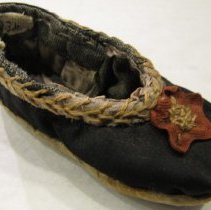
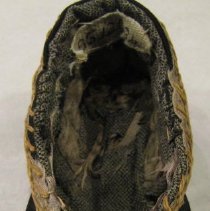
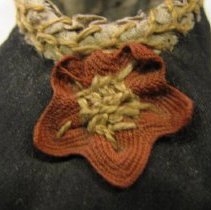
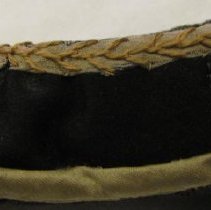
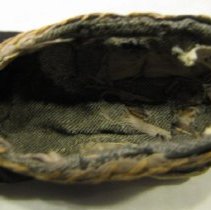
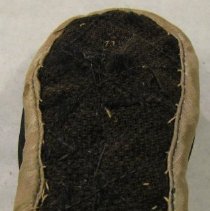
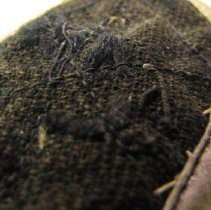
One of a pair of toddler slippers or shoes. The slipper is made from black sateen with a red ric-rack flower on the toe. A light pink ribbon is feather stitched around the top opening. The sole has a shiny fabric edging. The sole also has black fur or hair that is held in place by criss-cross stitching. |
Dimensions |
W-1.75 L-4.75 inches |
Made By |
Kreipke, Ingeborg |
Creation Date |
ca. 1902 |
Place Of Origin |
USA |
Owned By |
Oelkers, Vivian S. |
Material |
sateen/ribbon/ric-rack/fur or hair |
Associated People |
Oelkers, Vivian S. Kreipke, Ingeborg |
Search Terms |
Oelkers, Vivian S. Kreipke, Ingeborg shoe slipper toddler baby child clothing footwear children fur hair |
Provenance |
The slippers were made in 1902 by Ingeborg Hansen Kreipke, the donor's aunt. -------------------------------------- FAMILY HISTORY: Donor Vivian Oelkers' mother was Johanne Hansen Sorensen. The donor's maternal grandparents were Jens Peter and Johanne Hansen. The donor's maternal grandparents were Jens Peter Hansen and Johanne Maren Tinnersen. Jens Peter was a harness maker in Nykobing, Denmark. After Jens Peter's death in 1899, Johanne Maren approached her son-in-law, Carl Kreipke, about the possibility of the family immigrating. Jens Peter's cousin, Rasmus Hansen, had done well in lumber in Grayling, Michigan and had visited the family back in Denmark a few years earlier. Johanne and Jens Peter's eldest daughter, Anna, had already immigrated, married the brother of Rasmus Hansen, and settled just north of Grayling. Johanne wanted to take the rest of the family with her and be reunited with Anna. Son-in-law Carl Kreipke was a barber from Copenhagen. He had married Ingeborg Hansen in 1899 and the two lived in Copenhagen. Ingeborg was reluctant to leave Denmark, and Carl did not want to leave his mother; however, the promise of a better future persuaded him to agree to immigrate to the United States. In 1901, the Hansen family (Johanne Maren, six of her children, and Carl Kreipke) set sail on the steamship Hellig Olav. Only one sibling, Mary Hansen Jorgensen, chose to remain in Denmark with her husband and two small children. The family went to Grayling and stayed with Rasmus Hansen until a small house could be rented. Johanne Maren began cooking meals for the lumber workers to earn an income, and Carl Kreipke began working for Rasmus at the lumber company to pay back for the family's passage. Fortunately, Carl, who was unused to physical labor, was recruited to work in the bathhouse and barber shop for the lumber workers. He was able to repay the passage money. Meanwhile, Anna, the sister for whom the family had immigrated to the U.S. to join, died during childbirth to twins. One twin, Marius Hansen, survived and was raised by Carl and Ingeborg until the age of 12. Carl and Ingeborg later moved to Detroit. Carl joined the Danish Brotherhood and Ingeborg joined the Danish Sisterhood. The donor's mother, Johanne Hansen Sorensen, was only 14 years old when the family emigrated from Denmark. Although she had completed grade school in Denmark, she enrolled in the 4th grade because of the language barrier. Later, Johanne worked as a bookkeeper in the local furniture and undertaking parlor. She taught Sunday School in the Danish Lutheran Church, was active in the Young People's Society, and did folk dancing for entertainment. She married Axel Sorensen at an unknown date, and they had two daughters, Gerda and donor Vivian. Johanne died in 1976. |
Images |
203\1985120003b.JPG |
Date Received by Museum |
1985 |