
Object Record
Images
Metadata
Accession number |
1996.131 |
Object Identification Number |
1996.131.007 |
Object Name |
Plaque |
Donor |
Nielsen, Ruth, Herman |
Description |
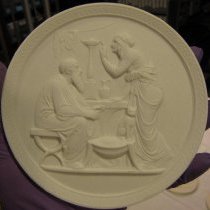
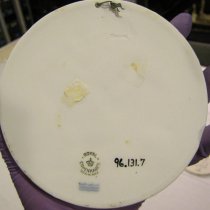
White plaster plaque, circular with straight sides. On the front is a raised design featuring a man seated on the viewer's left, wearing a robe and facing the standing woman to the viewer's right. There is a low pot on short legs between them and a table with a pitcher on it. The woman has an object in her left hand and a cat sits on the low pot in front of the woman. On back is the maker's mark in brown: "ROYAL COPENHAGEN" around a crown and "DENMARK" below, and three wavy blue lines below that. Just below the hanging wire is impressed "Eneret". |
Dimensions |
D-0.375 Dia-5.375 inches |
Title |
Winter |
Made By |
Thorvaldsen, Bertel/Royal Copenhagen |
Place Of Origin |
Denmark |
Material |
plaster |
Associated People |
Thorvaldsen, Bertel |
Search Terms |
Plaque Thorvaldsen, Bertel art Royal Copenhagen Winter |
Provenance |
FAMILY HISTORY: No information is in the file. PLAQUE INFORMATION This is a replica of one of Bertel Thorvaldsen's works. THORVALDSEN BIOGRAPHY Bertel Thorvaldsen (1770-1844) is one of Denmark’s best known artists. For more than 40 years he lived in Rome where he became one of the most important European representatives of Neo-Classicist sculptural art. Thorvaldsen was born in Copenhagen on November 19th, 1770, to poor parents. His father was a carver and immigrant from Iceland. His mother was the daughter of a parish clerk at the village of Lemvig. The young Bertel entered the Art Academy in Copenhagen at the young age of 11 with an unusually bright talent and was educated here as a sculptor until 1793. In 1796 he got the opportunity of travelling to Rome as the Academy’s scholar for three years to be further educated. Thorvaldsen arrived in Rome on March 8, 1797 and he stayed in the city, received numerous orders and became one of Europe’s best known artists. Not before 1838 did he return to Copenhagen. Thorvaldsens Museum was built from 1839 to 1848. Thorvaldsen died on March 23rd, 1844, and thus got so see large parts of the Museum finished. THORVALDSEN'S CAREER: The sculpture, which laid the foundation of Thorvaldsen’s fame, was Jason with the golden fleece from 1803. Contemporaries saw the sculpture as no less than an image of the ideal future for human kind. We are close to the French Revolution and the thoughts of new times with freedom, equality and brotherhood for all. Art and life were once again to be inspired by Roman and Greek Antiquity, e.g. Classical Antiquity and Classical art. This is why the art of the period is also called Neo-Classicism, and Thorvaldsen was early on and artistically very convincingly able to express this fusion between Classical art and the ideals of his time. After Jason Thorvaldsen received many orders. Rome was the cultural centre of Europe and attracted art interested people who could afford his works in marble or bronze. Thorvaldsen gradually had many employees and no less than five studios in Rome, and his works were placed all over Europe. THORVALDSEN'S MOST FAMOUS WORKS: Among his most famous works are the sculptures with motifs from Classical mythology, Venus, Mercury, Ganymede, Hebe, Cupid and Psyche. To this comes a number of monumental sculptures of historical persons, e.g. Pope Pius VII (a grave monument in St. Peter’s Basilica in Rome) and the equestrian statue of Jozef Poniatowski (Warsaw). Thorvaldsen also carried out large orders for Denmark; most famous of these are the statues of Christ and the Apostles (in Vor Frue Kirke – Church of Our Lady in Copenhagen). (Thorvaldsen information from Thorvalsens Museum website, 8/2014.) |
Images |
228\1996131007.JPG |
Date Received by Museum |
1996 |