
Object Record
Images
Metadata
Accession number |
1993.143 |
Object Identification Number |
1993.143.003b |
Object Name |
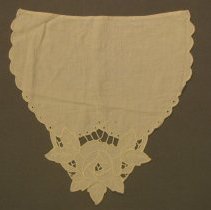
Doily |
Donor |
Budgell, Jenny Johansen |
Description |
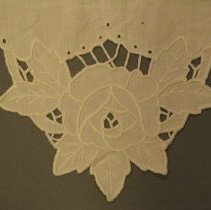
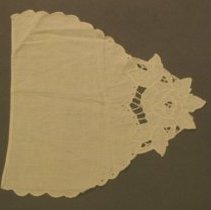
Armrest doily, also called an antimaccasar. One in a matching pair (1993.143.003a-b). Made from white linen. rough triangular in shape, with a white cutwork rose and leaf design at one point. Two sides of the triangle are scallop and have white button hole stitching, and the third edge is straight and hemmed. Small white eyelets near cutwork. |
Dimensions |
W-17 L-17.125 inches |
Made By |
Johansen, Jenny Jensen |
Creation Date |
1906 |
Place Of Origin |
Denmark |
Owned By |
Johansen, Jenny Jensen |
Material |
linen |
Associated People |
Johansen, Jenny Jensen Budgell, Jenny Johansen |
Search Terms |
Johansen, Jenny Jensen Budgell, Jenny Johansen doily armrest doily antimaccasar Denmark needlework cutwork rose leaves |
Provenance |
This pair of antimaccassars was made by the donor's mother, Jenny Jensen Johansen, in 1906. Jenny must have brought these armrest doilies with her when she immigrated to the U.S. in 1910. Jenny (née Jensen) Johansen was christened Jenny Alfine Frederikke Louise Amalie Jensen; her name was so long because four of her uncles wanted her named after them. She was a sickly child, not expected to live long. She was born to a family of twelve children, her being the only one without blond hair and blue eyes. Only seven of the children lived. Jenny Jensen's Grandma Knudsen lived with Jenny, her siblings, and Jenny's parents, Hans and Sine Jensen. Hans Jensen was a carpenter and a cabinet maker. He always had around 17 apprentices in the house. A woman came in every two weeks to do laundry and used a large boiler that would hold 20 sheets. Sine Jensen helped when needed. At one time Hans built a summer house on one side of their own house for Grandma Knudsen after she expressed her desire of one. He would even take her on walks in her wheelchair on sunny days. Hans went bankrupt early in the marriage and the family felt his death was a result of that. Upon Hans Jensen's death, Ludvig Johansen, the husband of Jenny Jensen, took in his mother-in-law, Sine. They were living in Copenhagen at that time. Ludvig had finished college and trade school at 17. He knew five languages plus Latin and chose cigar-making as his vocation. He sold everything and took his wife and mother-in-law to America to visit Jenny's two siblings, Ellen (Hansen) and Walter, who were living in the Chicago area. Starting off on April 21 on the "United States", they arrived May 4, 1910. Ludvig already knew English and Jenny learned through newspapers and listening to children. They lived on Morgan Street in Chicago and were surprised to find gas lights and outhouses as they had electricity and inside plumbing for a number of years in Denmark. After the Depression and World War II Ludvig went back to making cigars. Jenny and Ludvig never went back to Denmark but Grandma Sine Jensen returned after a year, dying some time later. Ludvig was the youngest of nine children. He and his brother were born after their oldest sister was a mother. His father, Ludvig August Johansen, was a grave keeper for many years, but went to California for one of the gold rushes between 1970 and 1880. He was also a caretaker at a cemetery in Nakskov, Denmark. When he went to California this left Ludvig's mother, Maria Jensen, with 7 children, and the care of the graveyard, garden and livestock. She was 4' 10" and weighed 95lbs. After Ludvig's father returned they had two more children, Ludvig being the youngest. Maria was alive when Ludvig and Jenny married in 1906, but died in 1923. |
Images |
029\1993143003b.JPG |
Date Received by Museum |
1993 |