
Object Record
Images
Metadata
Accession number |
2000.081 |
Object Identification Number |
2000.081.001a |
Object Name |
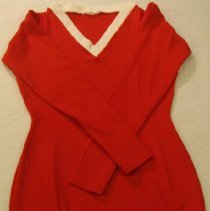
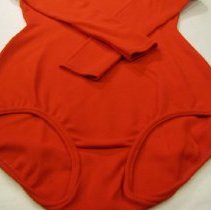
Bodystocking |
Donor |
Steffensen, Poul and Elie |
Description |
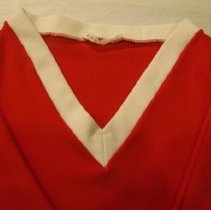
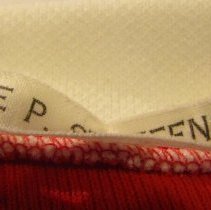
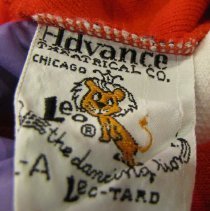
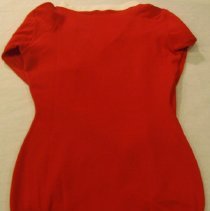
A women's gymnastic leotard. The bright red stretch nylon leotard has long sleeves and a "V" shaped neckline. The neckline is outlined with a white cotton binding. Each leg opening has elastic. A small white tag is sewn by hand to back of neck on the interior with a printed name that reads "ELIE P. STEFFENSEN." There is an additional tag along an interior side seam that has a cartoon lion and "Advance / THEATRICAL CO. / CHICAGO / LEO / the dancing lion / LEO-TARD" printed in black. |
Dimensions |
L-25 inches |
Made By |
Advance Theatrical Company |
Creation Date |
ca. 1960s |
Place Of Origin |
USA/Chicago/IL |
Owned By |
Steffensen, Elie |
Used By |
Steffensen, Elie |
Material |
nylon/cotton/elastic |
Associated People |
Steffensen, Elie Steffensen, Poul |
Search Terms |
Steffensen, Elie Steffensen, Poul Chicago Danish American Athletic Club gymnastics DAAC clubs sport sports athletics fitness woman bodystocking women gymnasts leotard Advance Theatrical Company |
Given In Memory Of |
Gift of Poul and Elie Steffensen |
Provenance |
This leotard is part of a gymnastics outfit owned by the donors. Elie Steffensen, donor, noted her family was heavily involved in the Danish American Athletic Club (DAAC) and other Danish organizations from 1930-1978. Her husband and other donor, Poul Steffensen, immigrated to the United States in 1951, and he also became very involved in DAAC. The gymnastic outfits in this gift were used by donors Poul and Elie in DAAC exhibitions and performances. ---------------------------- FAMILY HISTORY: The donors, Poul V. and Elie Steffensen, are #356 on the Wall of Honor. Poul immigrated in 1951 and Elie immigrated in 1929. They both settled primarily in Chicago, Illinois. Elie's parents, Christian & Karen Thinghøj Pedersen, are #1718 on the Wall of Honor. They immigrated in 1929 and settled primarily in Chicago, Illinois. Elie's brother, Paul Egon Thinghøj Pedersen, is #1719 on the Wall of Honor. He immigrated in 1929 and settled primarily in Chicago, Illinois. --------------------- Donor Elie (née Pedersen) Steffensen was one of two children born to Christian and Karen Thinghøj Pedersen. Karen (née Jensen) Pedersen was the daughter of L. M. Christian Jensen. She was one of nine children. In 1929, Elie's family immigrated to the United States. Elie was nine and her brother Paul was seven. The family settled in Chicago, Illinois, because both of her parents already had relatives living there. Elie's father had a sister and brother-in-law in Chicago, and Elie's mother had one brother and three sisters in Chicago. The family did not speak English at first, but they settled on the northwest side of Chicago known as the "Danish Colony." Christian found work with a Danish construction firm, but this job was short-lived, as the Great Depression hit the country soon thereafter. Christian and Karen then started a Danish boarding house called "Pensionat Rebild." They rented rooms to young Danish men and provided three meals a day. Elie's family quickly became involved in the various Danish organizations, including the DAAC (Danish American Athletic Club). Initially, there were no children's teams, but in 1930, at the age of ten, Elie was able to take gym with the ladies' team. This created an enthusiasm for children's classes, and by 1931, DAAC allowed children to join as Junior Members. A children's folk dancing team was also formed. This team performed at the 1933 Chicago World's Fair. Elie married a Danish immigrant named Poul V. Steffensen. Poul had immigrated in 1951 and settled in Chicago. They had two sons, both of whom were baptized and confirmed in the Danish Trinity Evangelical Lutheran Church. Their younger son, Carl, was last to be confirmed in 1972, before the church was sold to another congregation. ---------------------------- DAAC HISTORY: The Danish American Athletic Club, or DAAC of Chicago, Illinois was formed in 1922. DAAC met at various locations for its first six years, and then in 1928 the club bought St. Angar's Church, 1639 North Washtenaw Avenue, which was used for practices, exhibitions, and social gatherings until 1958. Then other sites were used until another building was purchased in 1963 at 4624 North Pulaski Road. Today the club's functions are held at the Scandinavian in Arlington Heights, Illinois. In the beginning DAAC sponsored wrestling, a soccer team and a senior boy's gymnastic team. Between 1924 and 1939 gymnastic teams were added for senior girls, ladies, junior boys and girls, and small boys and girls. Folk dancing teams were added for seniors, junior boys and girls and small boys and girls. Also introduced were basketball, baseball, table tennis and bowling. Those who participated in Danish folk dancing wore national Danish costumes and the gymnasts wore white gym suits trimmed in red with a DAAC emblem on the shirt or blouse. The Danish American Athletic club has been an enduring fixture of the Danish American community of Chicago, Illinois. It has provided a meeting place for new immigrants and their families to meet and socialize with one another. It has been a place where parents brought their children who could then learn some of the physical culture of the mother country. It has provided the forum for bringing Danish gymnastic and folk dancing teams to the United States and sending similar teams to Denmark. It rallied the Danish American Chicago community during World War II through the activities of the Danish War Relief. Through the past seventy-eight years the Danish American Athletic Club has for so many reasons served the Danish American Chicago community as an organization of exceptional value. ____________________________ Object included in the exhibition "Sports for Sports' Sake: Athletes and Ethnicity in Danish America" from April 23, 2016-September 4, 2017. |
Images |
201\2000081001a.JPG |
Date Received by Museum |
05/28/2000 |
Collection |
Danish Communities / Illinois / Chicago |