
Object Record
Images
Additional Images [6]
Metadata
Accession number |
1996.153 |
Object Identification Number |
1996.153.001a |
Object Name |
Belt, Sword |
Donor |
Nissen, Victor E. |
Description |
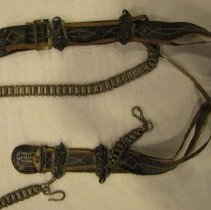
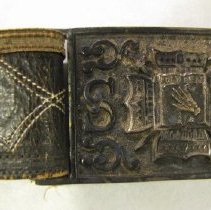
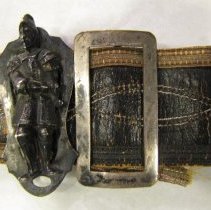
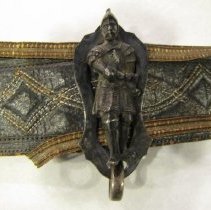
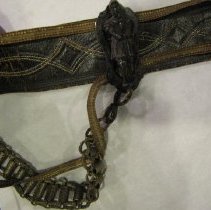
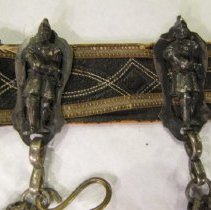
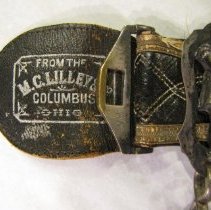
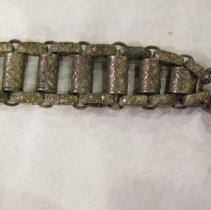
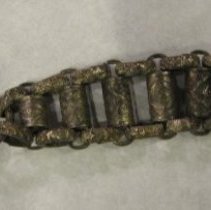
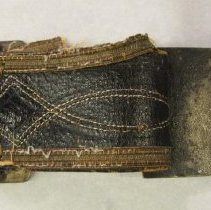
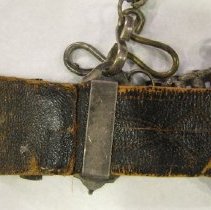
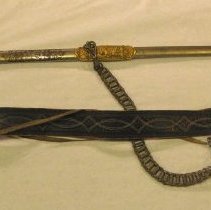
Black leather belt that is part of a sword, scabbard, belt set (see .001bc). Belt is almost 2" wide, has a brown ribbon trim sewn onto the front outer edges, and a white stitched sort of woven design through the center of the belt. The buckle is a rectangular silver metal piece. There are scrolled designs in each corner, and at the center is a sort of shield design with a Bible at the center with "HOLY BIBLE" at the top of it and a hand over top. Behind the shield are two crossed swords. On the viewer's left side of the Bible is "S" and on the right is "K". The opposite end is rounded leather with a silver stamp that reads "FROM THE / M.C. LILLEY & CO. / COLUMBUS / OHIO" inside a silver box. There is a silver metal piece just to the side of this that the buckle fastens onto. On that metal piece is "AA". Across the length of the belt are four adjusters or clips that are in the shape of soldiers in coats of arms. Each is dark silver in color. A thick silver chain connects the belt to the scabbard. Each chain loop is decorated with a raised design. |
Dimensions |
W-2 L-40 inches |
Made By |
M.C. Lilley & Company |
Creation Date |
ca. early 20th century |
Place Of Origin |
USA/OH/Columbus |
Owned By |
Hermansen, Niel |
Used By |
Hermansen, Niel |
Material |
leather/metal |
Associated People |
Hermansen, Niel |
Search Terms |
Hermansen, Niel Ancient Order of United Workmen M.C. Lilley & Company Columbus, Ohio sword weapon fraternal organization |
Provenance |
The sword, scabbard, and belt belonged to the donor's grandfather Niel Hermansen, a Danish immigrant. The sword represents the Ancient Order of United Workmen, of which Hermansen was apparently a member. It was part of a full-dress uniform worn by AOUW drill teams when they participated in parades. ____________ Organization information from www.phoenixmasonry.org (as of 12/2013): The American fraternal benefit network began with the organization the Ancient Order of United Workmen in Meadville, Pennsylvania on October 27, 1868. The AOUW was founded by John Jordan Upchurch, a Mason, with the aim of adjusting "all differences which may arise between employers and employees, and to labor for the development of a plan of action that may be beneficial to both parties, based on the eternal truth that the interests of labor and capitol are equal and should receive equal protection." Each member paid $1 into the insurance fund to cover the sum of not less than $500 in benefits paid to a member's dependents when he died. Each time a member died, $1 was due from the surviving members to reestablish the fund. Fraternal benefits societies soon became quite popular as a means of providing financial protection to working class people at an affordable rate. Additionally, Fraternal benefits societies typically maintained a lodge where members could meet together in a spirit of fraternalism and brotherhood. In at least one case - the Populist movement - the fraternity evolved into a powerful political organization providing a voice for their members. Although John Upchurch did not intentionally seek to establish a new system of insurance, the seed of his original idea was in fact planted. The crux of Upchurch's ideology was to "bring together then conflicting social interests, capitol and labor, to provide a means of arbitration with which to settle difficulties that were constantly arising." However, that seed, once planted, grew into the tree of mutual protection, "under whose shelter millions today rest in security from want and dependence." The emblems and symbols used by the AOUW are steeped in Masonic attributes, featuring the All-Seeing Eye, the Holy Bible, Anchor and Square and Compasses, over which the motto "Charity, Hope and Protection" are displayed. It even boasts of having three independent degrees as a rite of passage into the order. Its membership numbered in excess of 318,000 in 1895. Quoted from an excerpt of a lecture given by Upchurch defining the AOUW, the pervasiveness of the tenets of Masonry are easily recognized, when he said, "Today we have members from the highest professions and the lowest grades of mechanical labor. We come into this organization on the same great level. It is not money, but it is purity of character and uprightness that brings us here, and we can take each brother by the hand as an equal. Brothers, in this organization we have done more to harmonize the human family, high and low, than all the other organizations that ever existed." The AOUW was the first fraternal benefit society to provide life insurance to its members. The organization was fairly common in the Midwest in the 1890s and was in existence until 1948 when it was mutualized and became part of the Pioneer Mutual Insurance Company of Fargo, North Dakota. ______________ Manufacturer information from www.columbusmemory.org (as of 12/2013): Founded in the mid-1860s, the M. C. Lilley Company was world renowned as manufacturers of regalia. Regalia is defined as magnificent attire, finery." Besides ceremonial swords, the Lilley Company produced banners, flags, emblems, and uniforms for fraternal societies and organizations such as the Mason Fellows, Knights of Pythias, and policemen. Lilley also supplied the U. S. Marine Corps and the cadets of West Point and Annapolis with swords. During World War II, the company made thousands of machetes for Dutch troops. Their goods were shipped all over the United States, Canada, and even Australia. The company was founded by four leading citizens of Columbus, Ohio all veterans of the Civil War. They were Mitchell Campbell Lilley, John Siebert and brothers Charles and Henry Lindenberg. All four men were members of the Odd Fellows and published the "Odd Fellows Companion", a publication of the fraternal organization. Through their newsletter, they received many requests from people wanting to purchase regalia. They decided to produce the items themselves and thus a company was born. The company first occupied a small building at 253 S. High Street, but grew into four large buildings at the corner of E. Long and N. 6th streets. When the Depression hit in 1933, the company was bought out by Hendersen-Ames of Kalamazoo, Michigan and the name was changed to Lilley-Ames. It officially went out of business in 1965. |
Images |
208\1996153001a.JPG |
Date Received by Museum |
1996 |